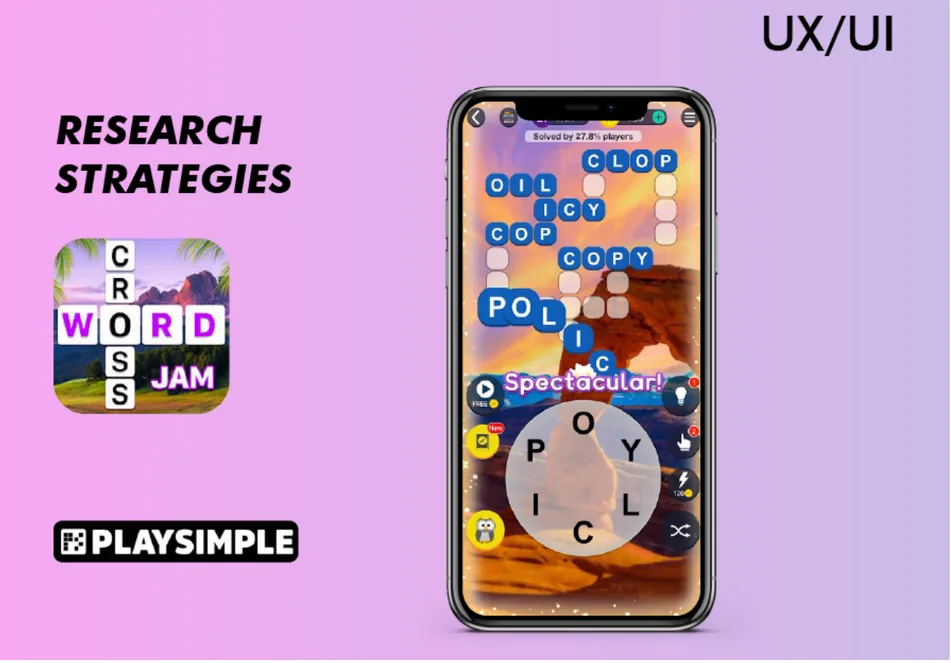
Six months, solo, inside Crossword Jam at Playsimple — building a research toolkit for a product class that conventional UX methods quietly don't fit: casual F2P mobile games.
Standard UX research methods — lab studies, moderated usability tests, contextual inquiry, think-aloud protocols — were built for enterprise software and consumer web apps. Casual F2P mobile games break several of their assumptions at once.
The primary player is 45+, global, playing in 3-minute snatches between other things. They are exactly the demographic least likely to accept a Zoom interview about a word puzzle. Even if they did, the Hawthorne effect would distort what you measured — being observed playing a casual game reshapes the play. The whole point of a casual game is that no one is watching.
You have, instead, two kinds of data. Hard quantitative signals — retention curves, session length, conversion funnels, A/B test deltas — tell you what is happening but not why. And the game's own surface — every competitor's build, every screen, every loop, every monetisation hook, observable to anyone with the App Store and patience. The research strategy has to do most of its work in that second register: the games themselves as the research substrate.
Over six months, the work became a small library of repeatable frameworks — three in particular did most of the heavy lifting. This case study is about those three.
Each framework answers a different question. Together they form a playbook that a single researcher can run against dozens of competitors in a week, and produce arguments a product team can actually argue with.
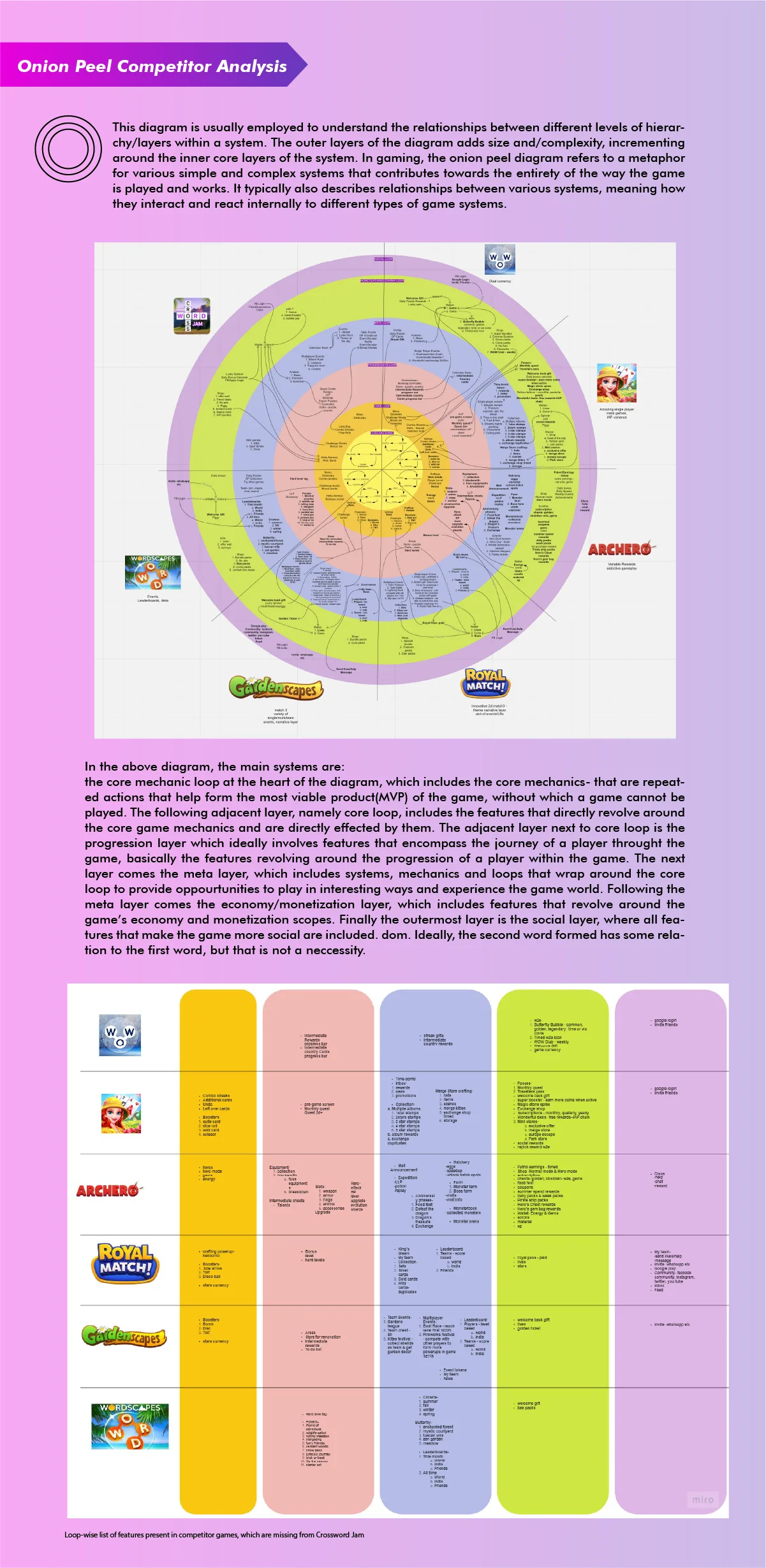
The Onion Peel method treats a game as a set of nested systems. At the centre sits the core mechanic — the single action a player repeats that defines the product. Every other layer orbits it, adding complexity and meaning the further out you go.
The seven rings, from inside out:
Placed side by side — Crossword Jam and its direct competitors across the same seven layers — the Onion Peel surfaces a shape of investment. Two games may look similar at the core and differ sharply at ring 5 or 6. One game may be hollow in the middle but heavily social on the outside. Those shapes are arguments: we are under-investing in meta compared to peer A; we are over-investing in social compared to peer B; our economy ring does twice the work it should because layer 5 is empty.
The framework also composes with others. The meta layer at ring 5 is exactly where the Collection System proposal eventually landed — that case study is a direct downstream artifact of a competitor teardown that showed meta-hollowness across peers.
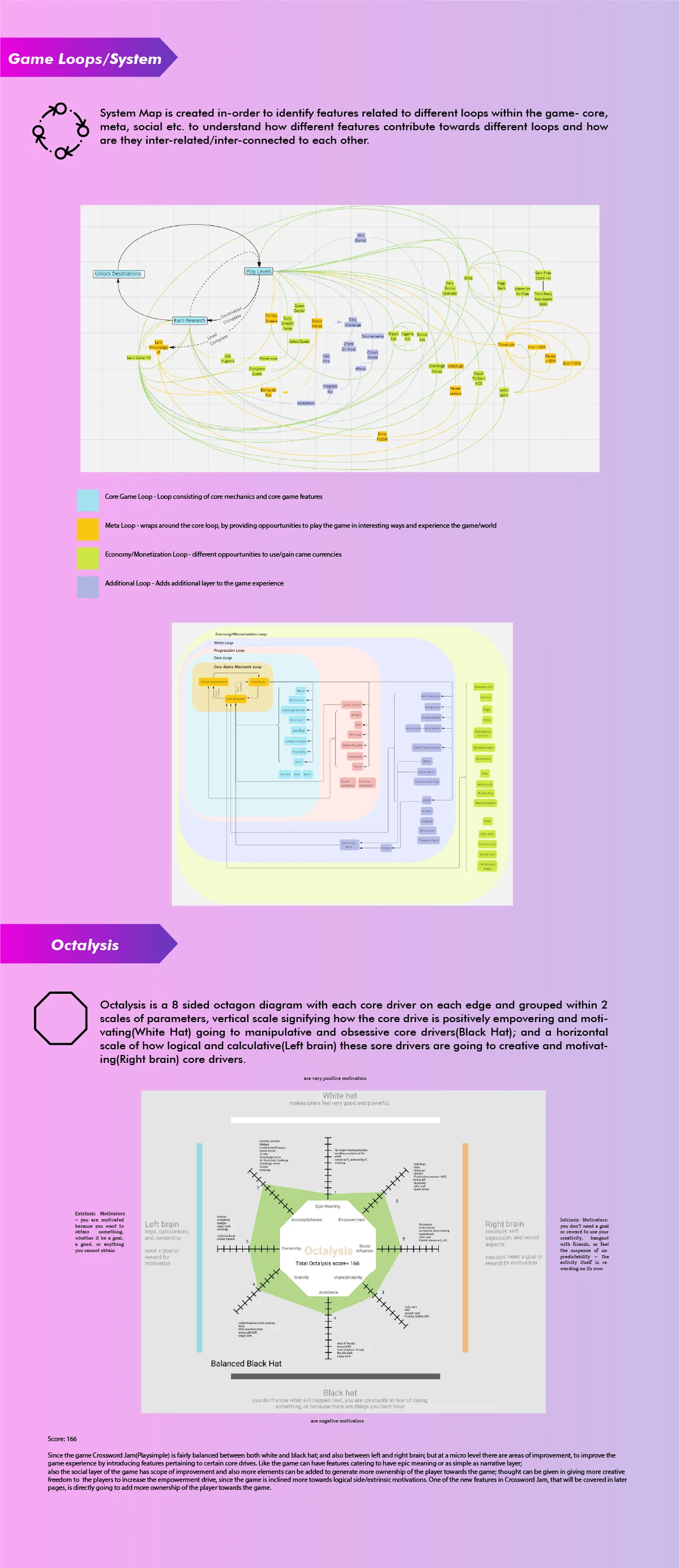
Where Onion Peel answers "what layer is this feature on?", the System Map answers "what does this feature connect to?". It's systems thinking in the lineage of Donella Meadows — nodes and edges instead of rings.
Each feature is a node. Each feature also belongs to one or more loops (core / meta / social). Edges connect features that reinforce each other: shared state, shared rewards, shared player motivation. The map is colour-coded by loop — a blue node sits in the core loop, yellow in meta, green in social.
The insights come not from the nodes but from the edge density. A feature with five strong edges is load-bearing; tearing it out breaks four other features. A feature with one edge is an orphan; it may be live in production but it's floating. A loop whose internal edges are all thin is a loop that looks like a loop but isn't actually closing on itself — the player isn't getting pulled back by anything.
Two structural patterns recur, once you start drawing these maps:
Yu-Kai Chou's Octalysis framework — an 8-edge octagon mapping the eight core motivational drives a game can pull on — does the third job in the toolkit. Onion Peel tells you what the game has. The System Map tells you how the pieces fit. Octalysis tells you why anyone is playing.
Two perpendicular axes cut through the octagon. Vertical: White Hat / Black Hat — whether the drive is motivating through growth and meaning, or through loss aversion and compulsion. Horizontal: Left Brain / Right Brain — whether the drive is calculative/extrinsic, or creative/intrinsic. A healthy game uses both hemispheres and both hats, in deliberate balance. An unhealthy one over-indexes on one quadrant — usually Black-Hat-Left-Brain, the "addictive extrinsic loop" quadrant that produces spectacular short-term engagement and spectacular long-term churn.
Applied as a teardown tool across peers, Octalysis surfaces the motivational profile of a competitive set. Two word games can have nearly identical core mechanics and radically different motivational shapes. One might lean on Scarcity (Drive 6) and Unpredictability (Drive 7) to keep players returning; another on Ownership (Drive 4) and Social Influence (Drive 5). Those are different products, even when they look the same at ring 1 of the Onion Peel.
Ran across a set of peer and adjacent casual word games, the three frameworks produce a single comparative artefact — a long-form teardown that places each competitor next to the others along the same axes. Below: a composite of that work.
Running the same three frameworks across ~8 competitors stops being a research exercise and starts being an argument-generator. Every feature pitch at the subsequent product-planning session could be anchored to: "peer A invests here, peer B doesn't, we're between them; based on the System Map this change would reinforce the meta layer without destabilising the core loop; Octalysis says we'd be paying Drive 4 and borrowing from Drive 6, which is fine because we're currently over-indexed on 6."
That kind of argument is only available to a team that has done the teardown work. The whole point of the toolkit is that the work, once done, is durable. The Onion Peel diagrams age well — the layers themselves don't shift even as specific games update. The System Maps take a week to refresh. Octalysis audits take a day. This is why the frameworks were the deliverable, not the individual reports.
The durable output of this engagement wasn't any single research report. It was a small, repeatable playbook a single researcher could run against any casual game — competitor, partner, or the company's own product — and produce the same kind of argument, in the same shape, every time.
The effect on product conversations was the most visible thing. Once a team shares vocabulary — "we're hollow at ring 5", "that feature is an orphan node", "we're over-indexed on Drive 6" — the conversations themselves become shorter and more structural. Nobody is arguing from taste. Nobody is arguing from authority. Both parties are pointing at the same diagram.
The frameworks travelled downstream too. The Collection System proposal that eventually shipped was a direct application of the toolkit — Onion Peel flagged meta-layer hollowness, Octalysis flagged Drive 4 weakness, System Map showed that ownership rewards weren't reinforcing any loop. All three tools, pointing at the same gap, made the case for a new feature before a single wireframe existed.
Systems thinking, teardown rigour, and a motivational audit: together they turn a casual F2P game into something a single researcher can argue about with the specificity that more heavyweight UX environments take for granted.