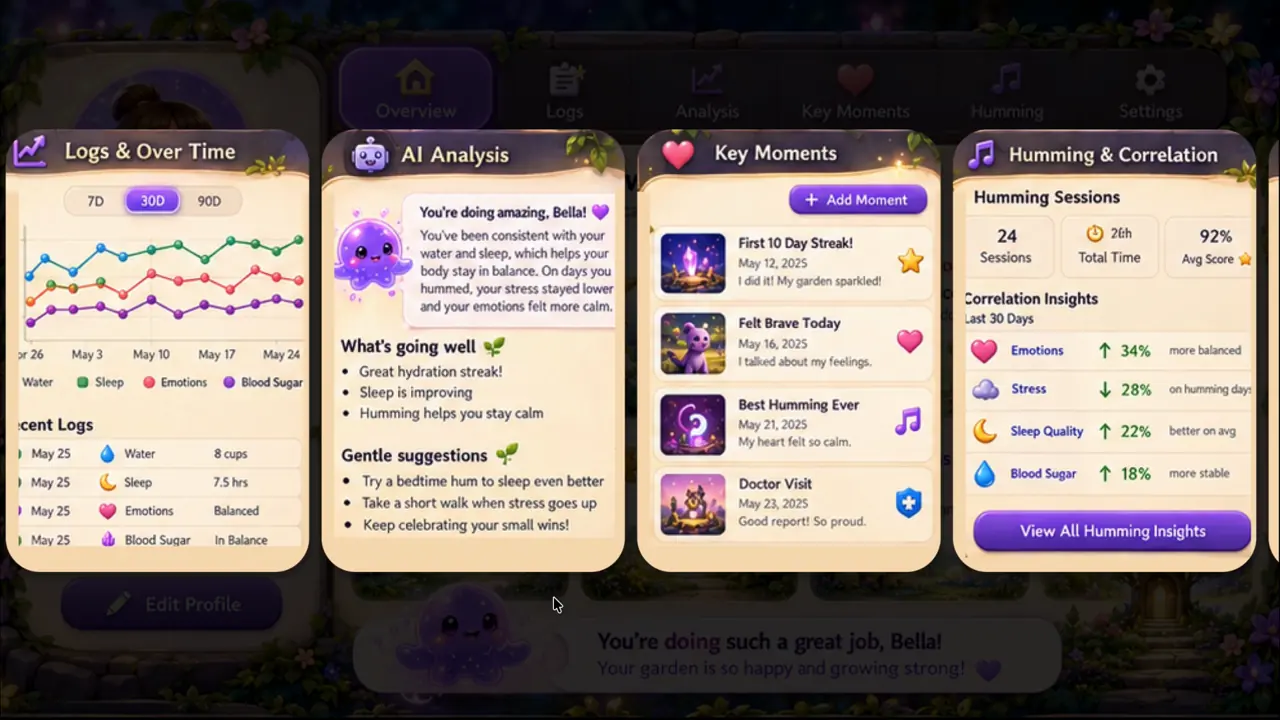
A cozy self-care garden game for children — built first for kids managing Type 1 Diabetes — where a magical garden and nine emotion pets carry the weight of daily self-tracking, and the core mechanic is a hum: a voice-powered biofeedback dial that opens gates on a magical rollercoaster. Designed at The Verse; engineered down to the autocorrelation window; backed by actual peer-reviewed breathing science.
A child managing Type 1 Diabetes carries a quiet, permanent workload: log this, measure that, notice how you feel, report it to adults. The tools we hand them are usually trackers — and trackers come with an emotional bill. Numbers can read as grades. Missed days can read as failure. The data piles up on the child.
And the brutal truth about wellness apps generally: people stop opening them. In the largest objective study of real-world mental-health app usage, the median app kept just 3.9% of its users opening it daily by day 15 (Baumel et al., 2019, Journal of Medical Internet Research). Fifteen days. The category's retention problem isn't a UX detail — it's the whole ballgame, and it's why Riley is a game first, with the therapeutic machinery hidden inside things a kid would choose to do anyway.
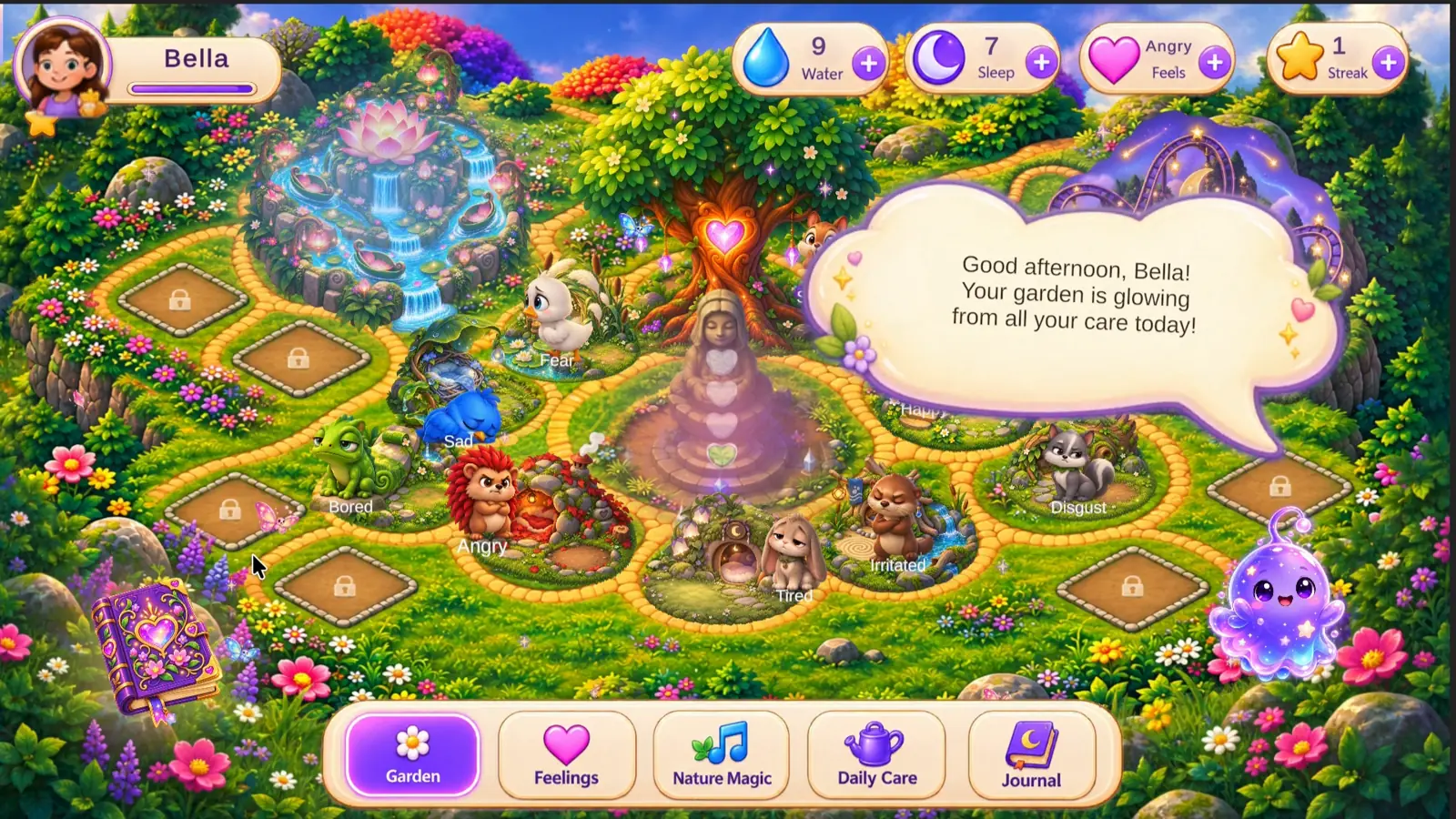
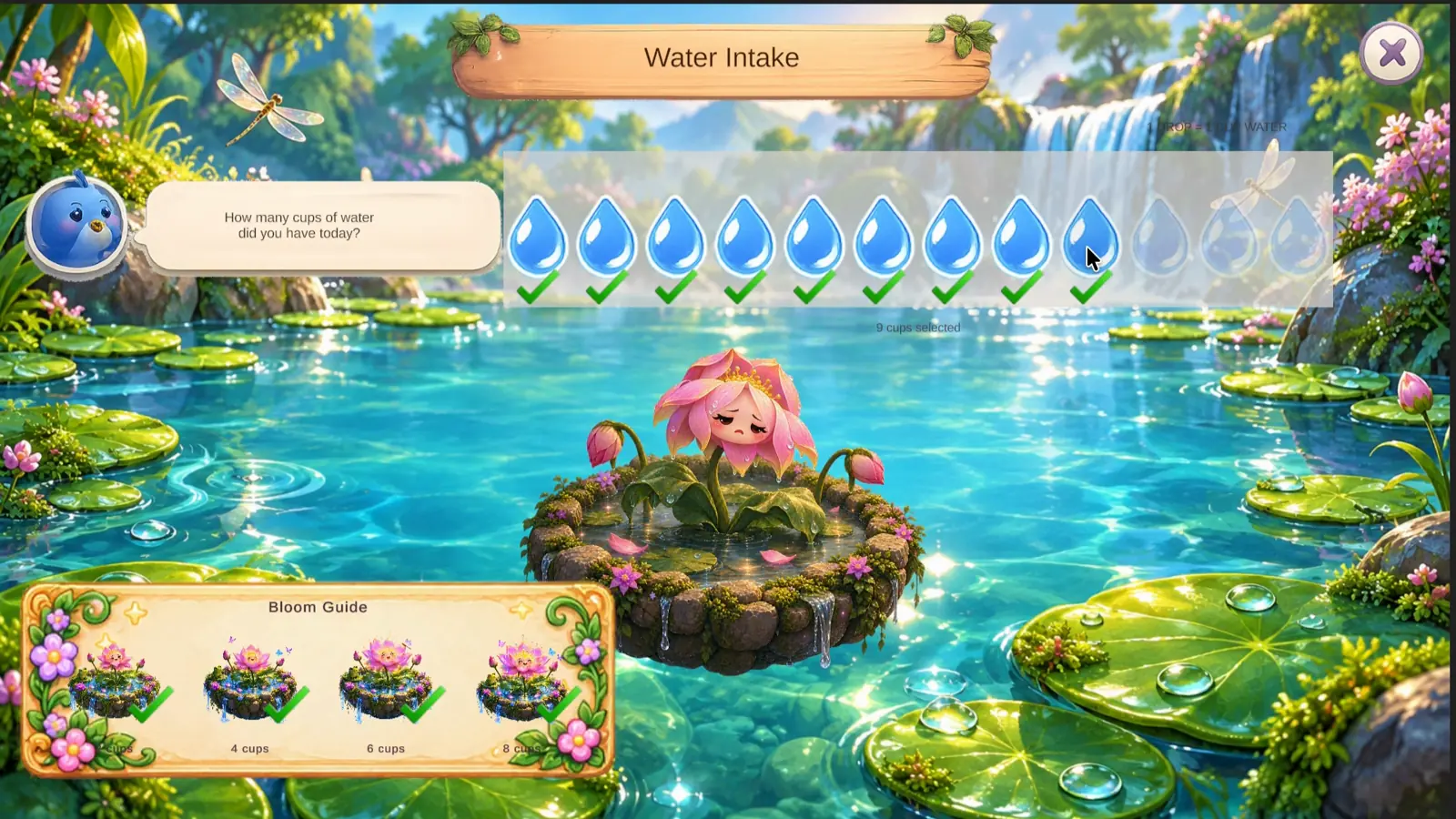
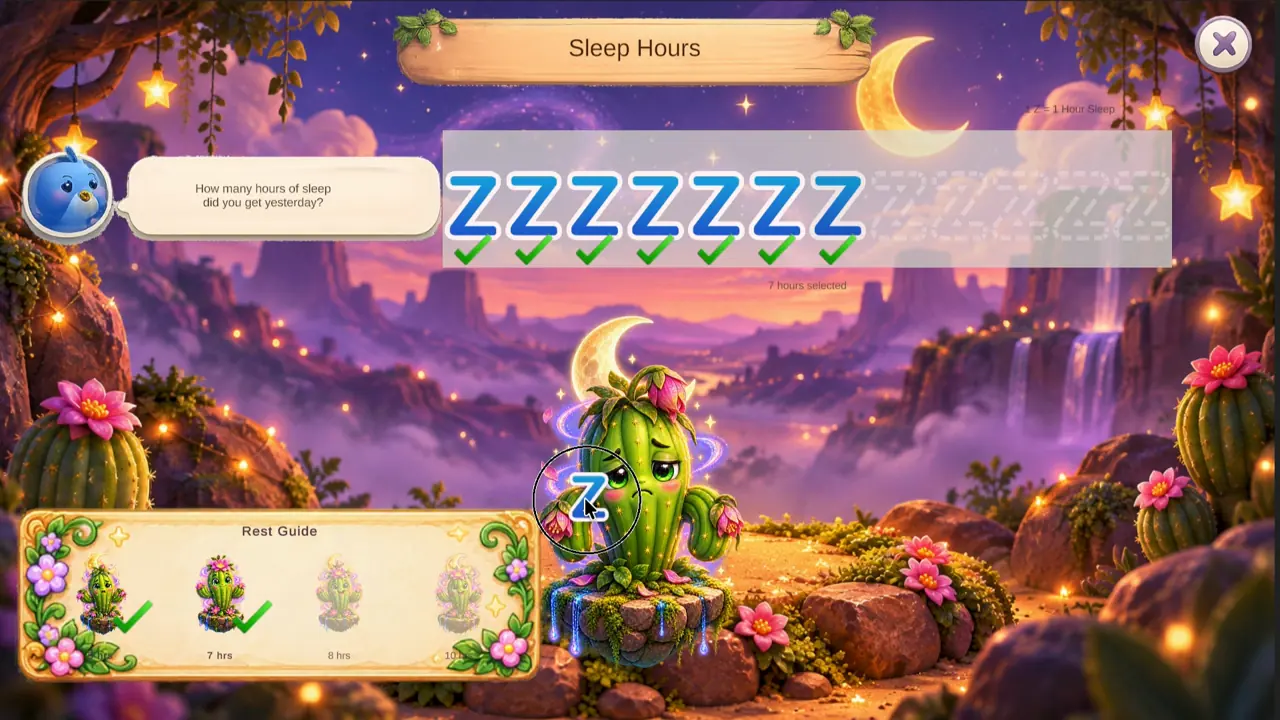
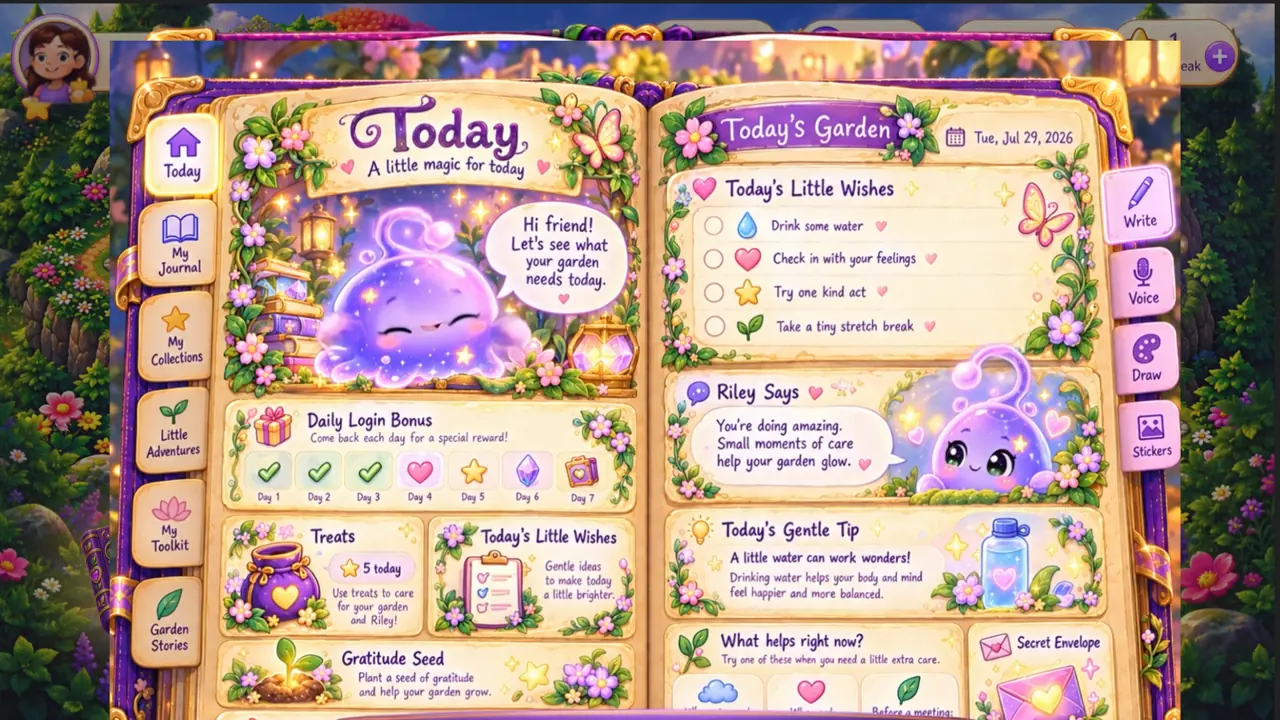
Riley's design answer is externalization: the garden and its creatures carry the data so the child doesn't have to. Water you drank becomes a lotus blooming in a pond. Sleep becomes a moon cactus earning its star crown. Feelings become nine pets who live in the garden whether you log them or not. The child isn't filling out a form; they're caring for someone. The self-care is smuggled in through pro-social motivation — kids who find it hard to do things for themselves will reliably show up for a creature that needs them.
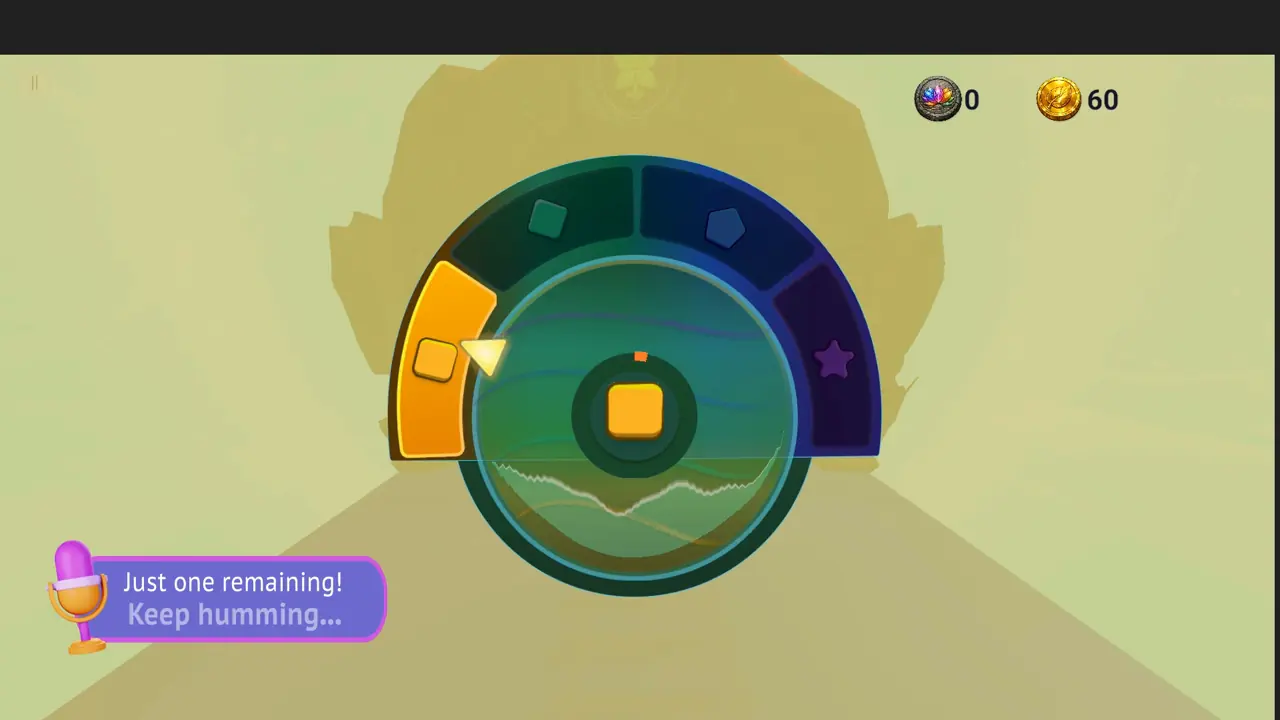
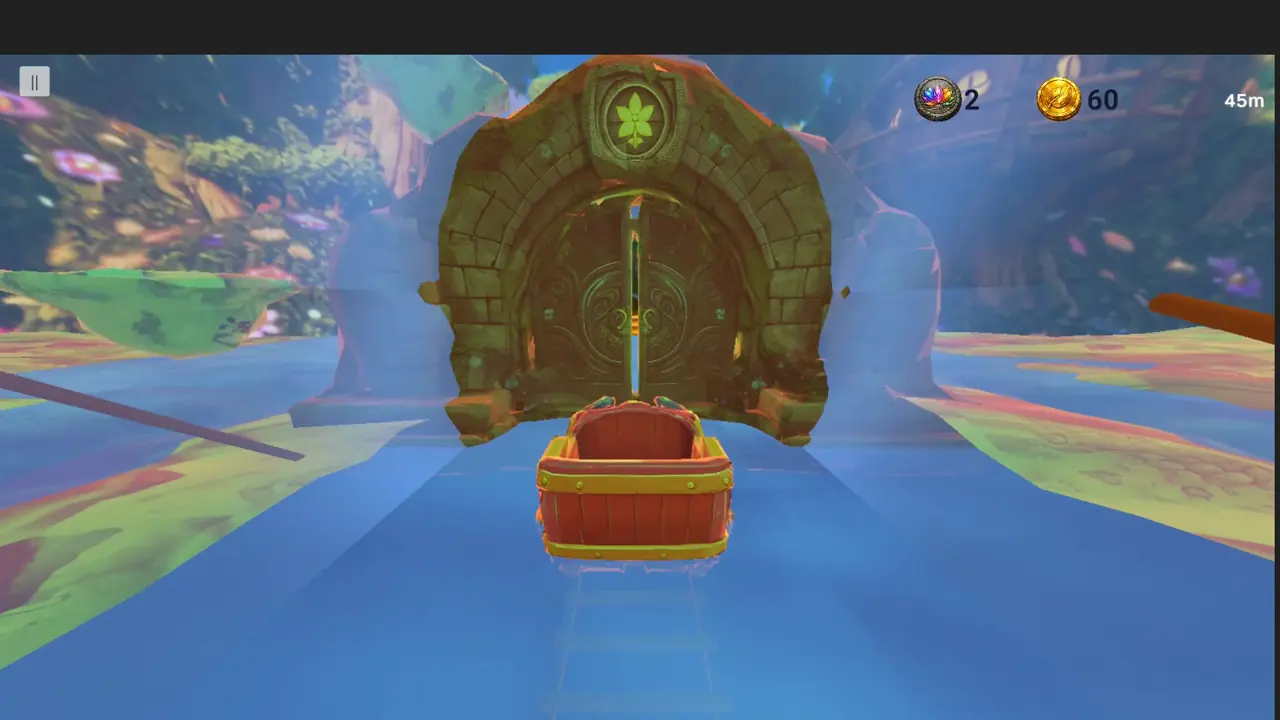
This is the interactive hero I built for the game's page on the Verse site, running live right here. Hold the button (mouse, touch, or Space/Enter) and the dial fills exactly like the in-game HumDial. Fill it, and Riley's Starflower gate — rendered from the game's actual 3D gate model into frame and door layers — slides open. Let go early, and the dial drains. Riley also appreciates being tapped.
Everything in this demo mirrors a real system decision: the dial's fill-and-drain envelope, the gate's door choreography, the sparkle burst on completion, even the ~Hz readout flutter — a nod to the pitch tracker you'll meet in the next section. On the Verse page this whole stage runs on transform and opacity only, honors prefers-reduced-motion, and weighs about 2 MB.
You cannot hum while inhaling. (Go ahead, try — I'll wait.) That one piece of physiology is the whole trick: asking a child to hum is asking them to produce a long, controlled exhalation without ever saying the words "breathing exercise." Slow exhale-weighted breathing shifts the autonomic nervous system toward its parasympathetic, rest-and-digest mode, and at around six breaths per minute it hits the cardiovascular system's resonance frequency — the pace at which heart-rate variability swings widest and the baroreflex gets its best workout (Lehrer & Gevirtz, 2014; Zaccaro et al., 2018).
Singing research backs the vocal route specifically: structured song measurably organizes singers' heart-rate variability, with slow exhalation phases driving vagally-mediated heart deceleration (Vickhoff et al., 2013, Frontiers in Psychology). And for the trivia drawer: humming increases nasal nitric oxide roughly 15-fold over quiet exhalation — 189 to 2,818 nl/min in the classic measurement (Weitzberg & Lundberg, 2002, Am. J. Respir. Crit. Care Med.). That one's a respiratory curiosity rather than a calm claim, but it is a genuinely funny thing for a children's game mechanic to have in its bibliography.
Then there's the engineering, because "detect a child's hum on a phone" is a genuinely hard signal-processing problem. The HumDial — documented in its own 29-page whitepaper — listens through the microphone and extracts five features per frame from a 2,048-sample (~46 ms) window: amplitude, pitch, stability, harmony, and voice confidence.
Each day's ride begins with an emotion check-in — the nine pets, plus intensity sliders — which seeds a stress score. That score does real systemic work: the number of hum gates on today's track is interpolated from it (calm day, 2 gates; stormy day, up to 5), and it sets the starting level of the ride's internal stress engine. The design principle: difficulty scales with state, not skill.
The tunnel itself is a hand-written URP shader on the inside of a cylinder: ring density follows pitch, noise-smear follows instability, and holding a note near the A3–C4–E4 triad for half a second triggers Harmony Mode — the whole tunnel lerps to gold. The child's voice is, quite literally, the lighting rig.
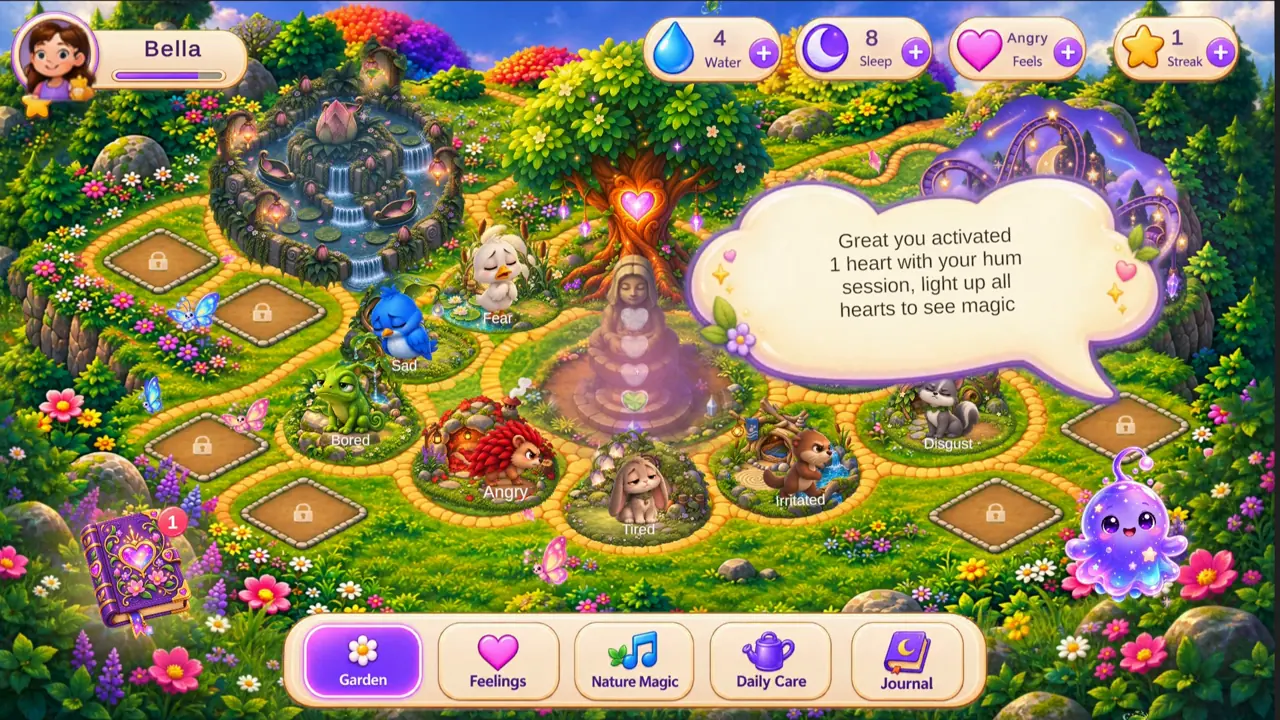
The garden's emotional core is its nine pets — a golden puppy for happy, a blue rain-bird for sad, a white duckling for fear, a leafy-collared wolf pup for disgust, a red-quilled hedgehog for angry, a squirrel for surprised, a chameleon for bored, an otter with permanently crossed arms for irritated, and a sleepy pink bunny for tired. Tap one below, exactly as kids do in the game's check-in.
Tap a friend. Every feeling is welcome.
The happy puppy is so glad you came to the garden!
every feeling is welcomeThis isn't just charm — it's an affect-labeling machine. Putting a feeling into words measurably dampens the amygdala's response to emotional stimuli while recruiting the prefrontal cortex (Lieberman et al., 2007, Psychological Science) — the finding popularized as "name it to tame it." Riley's twist is that labeling happens by choosing a creature, which lowers the ask for kids who can't yet articulate "irritated" but can absolutely point at the otter with crossed arms.
Two design decisions do the heavy emotional lifting. First, the difficult pets are always present — anger and fear live in the garden like everyone else; they are never banished, because the game must never imply that negative feelings are wrong to have. Second, logging a hard feeling triggers a compassion animation — the happy puppy nuzzles the hedgehog — and the hedgehog says, "Thanks for seeing me. I feel a little less alone." Honest reporting is rewarded with warmth, never corrected.
Around the pets, the rituals: drag water drops into the Lotus Pond and the lotus climbs from wilted toward radiant bloom; feed last night's hours to the Moon Cactus and it earns its star crown at a full night's sleep; the Hum Statue's four gem hearts light with each completed ride; and the Rainbow Tree glows only on days when everything aligns — celebrated when it happens, never shamed when it doesn't.
Most habit products are quietly built on loss aversion: streaks that shatter, plants that die, auras that gray out. That pressure works — on adults, briefly — but aim it at a child who already associates health data with being judged, and you've built a shame engine with a mascot. Riley's answer is a set of non-negotiable system rules, written into the design doc as constraints, not vibes:
There's respectable motivation science underneath — self-determination theory's case that autonomy and warmth beat pressure for behavior that has to last (Deci & Ryan) — but the honest origin is simpler: this game is for a child who might be having a genuinely hard week. Every system was audited against one question. What does this feel like on a bad day?
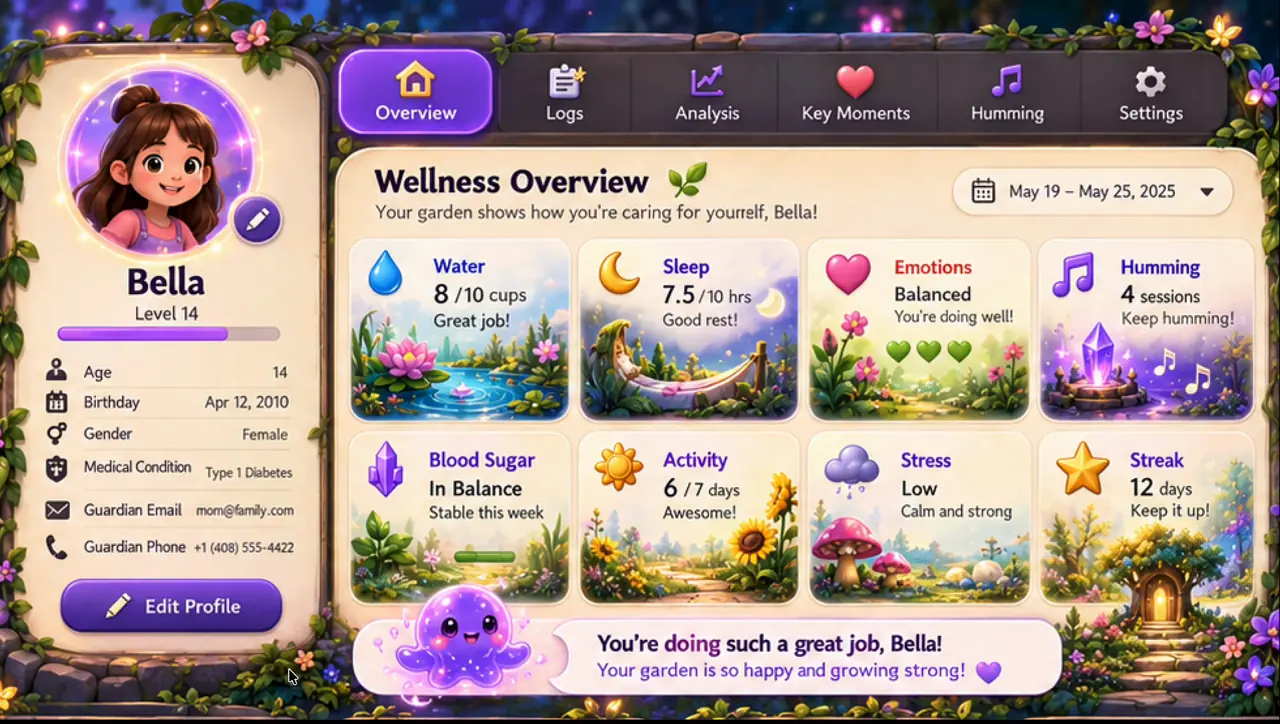
Behind a four-digit PIN keypad lives the adult view: seven-day hydration and sleep charts, an emotion breakdown, hum-session counts, and a "Humming & Health" correlation view that lines humming up against the rest of the week. There's even an exportable guardian report for doctor visits — deliberately written in observational language with its limitations stated, because a children's game should inform a clinical conversation, never impersonate one.
The data posture is conservative by design: everything is local-first on the device — no backend, no account, no telemetry of feelings leaving the phone. And the planned insight layer is deterministic-first: statistical patterns are computed first, and any AI involvement is restricted to explaining validated patterns, never inventing them, with blood-sugar-adjacent correlations held to exploratory language only. The central principle, verbatim from the spec: the child must feel cared for — never judged, medically monitored, or punished.
Riley has lived two lives. Era one (March 2026) was a "personalized emotional rollercoaster" through the body's inner world — emotion-driven procedural rides, food choices, spike physics. It worked, and it taught us what the real product was. The June 2026 InnerGarden pivot kept the two systems that had proven themselves — the HumDial and the stress engine — and rebuilt everything around them as a daily garden for kids managing T1D. Killing the runner framing was the best design decision of the project; the hum was always the hero, and the pivot finally admitted it.
My Friend Riley is in active development at The Verse: the hum ride, garden, pets, rituals, journal, and Grownups Vault are built and playable; themed rides, deeper insight layers, and wearable/CGM integrations are on the roadmap — the long-term ambition being a game whose health-outcome data is worth publishing, not just shipping.
What I'll carry forward from this one: the mechanic should be the therapy, not decoration around it; externalizing a child's data into creatures they care for turns tracking from a mirror into a friendship; and a genuinely kind system is a set of hard engineering constraints — no fail state, a capped retry loop, a microphone pipeline that adapts to every voice — not a tone of voice in the UI copy.