← back to portfolio
Case Study · 00 / 11
Case Study · AI-Native Pipeline · 2024–26 · Three games shipped

An AI-native game-dev pipeline.

A production pipeline I assembled from ChatGPT, Claude, Claude Code, Meshy, Blender, Flow (labs.google), Suno, ElevenLabs, and Firebase — used to ship three games across mobile, desktop, and VR with a one-to-three-person team. Not "AI did it." AI in specific roles, with the human owning the decisions that matter.

Role
Designer-Developer-Engineer
Span
2024 → 2026
Stack
ChatGPT · Claude · Claude Code · Meshy · Suno · Flow · ElevenLabs · Blender · Firebase
Platforms
Mobile · Desktop · VR
Games
The Karma Project · My Friend Riley · Baba on the Go
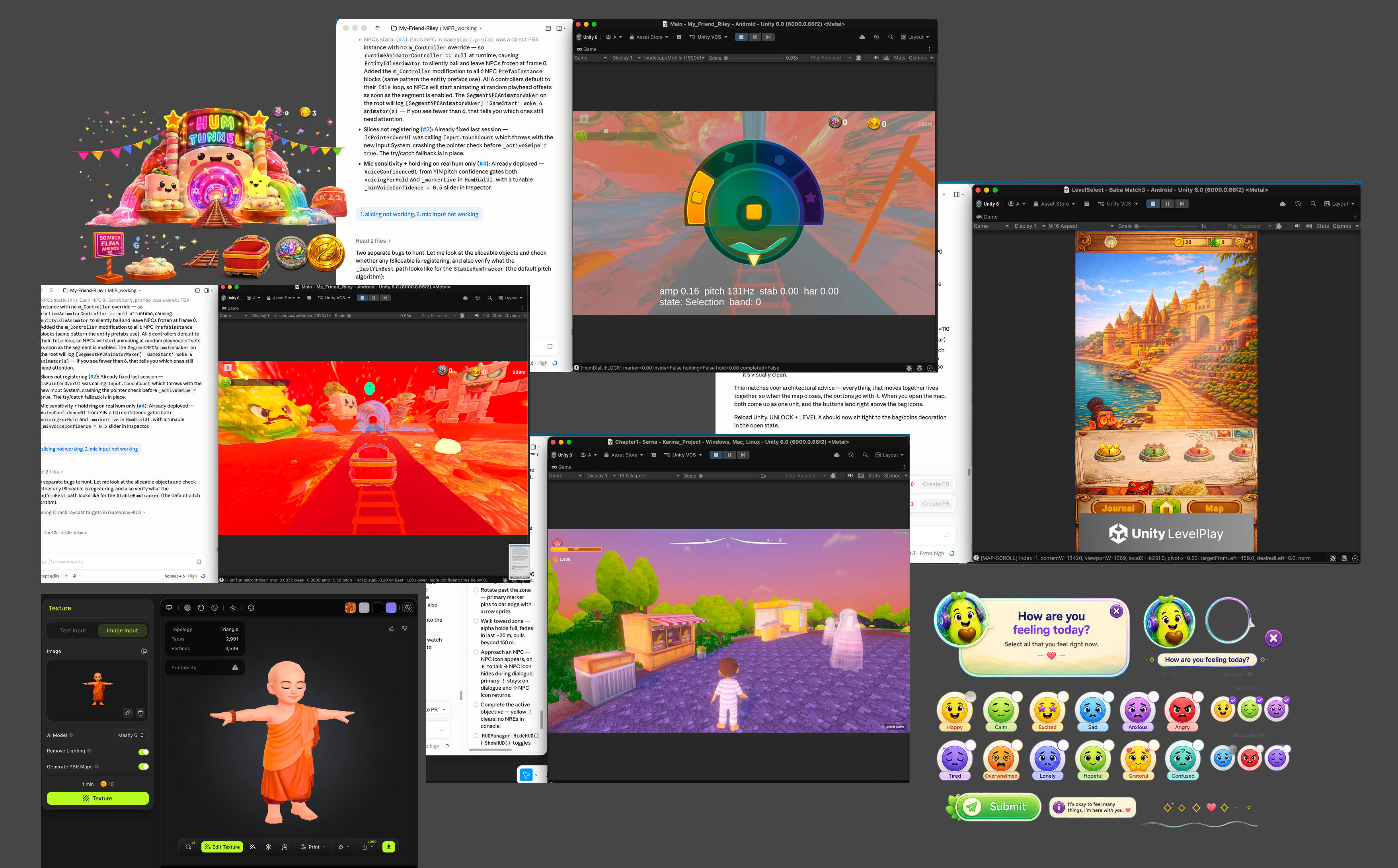
AI-native pipeline hero — composite of three games (Karma Sammy + ghosts, Baba Match-3 LevelSelect, Riley HumDial + lava world, Meshy Hum Tunnel + Ananda monk, Emotions Journaling stickers)
§ 01 / Context

Indie game-dev is a bandwidth problem.

↳ what AI actually changes

A modern game needs concept art, 3D models, animation, music, voice acting, narrative, dialogue trees, level design, UI/UX, gameplay code, telemetry, monetization, store-page assets — each historically a specialist's full-time job. A solo developer or two-person team has to drop scope, hire fractionally, or burn out.

The 2024–25 generation of AI tools doesn't replace specialists. What it does is collapse a specific bottleneck: the time between thought and prototype. Done well, this lets a small team operate at studio scope without studio headcount. Done badly — and most attempts are done badly — it produces generic slop and a graveyard of half-built features.

The difference is the discipline: what you delegate, what you keep, and how the tools compose as a pipeline rather than a heap of browser tabs. This case study walks through the pipeline I built — and the rules I follow to keep it from devolving.

AI tools amplify intent. They do not generate intent.
§ 02 / The Pipeline

Eight stages. One human in every loop.

↳ what each tool actually does

Every project moves through these stages. Most tools serve exactly one stage; a couple (Claude, ChatGPT) sit across multiple. The point isn't tool count — it's that each stage has a primary tool with a known failure mode, so I know what to verify.

  • ChatGPT & Claude (chat). Thought-partner work. Brainstorming chapter arcs, mechanic concepts, narrative beats, competitive research. Claude leads when the question needs structural reasoning across long context; ChatGPT is faster for quick lookups and content tagging.
  • Claude (vision) + ChatGPT. Design critique with vision input — paste a screen, get specific feedback on hierarchy, contrast, motion grammar. Used as a second opinion before in-engine commits.
  • Meshy → Blender (with Claude). Meshy generates text-to-3D and image-to-3D base meshes from concept sheets. Output is never ship-ready — Blender does cleanup, retopology, UVs, materials. Claude helps via Blender's bpy Python API for batch operations and parametric edits.
  • Flow (labs.google) + Figma. Flow generates short motion-video previews of UX concepts before any in-engine prototype is built. Saves Unity-side throwaway work; you see what an interaction feels like before you commit to building it.
  • Suno. Original tracks for chapter themes, ambient loops, level music. Drafts come fast; the keepers go through a DAW pass for mastering and length-cutting.
  • ElevenLabs. Character voices for narration, dialogue, and bubble lines. Consistent character voices across hours of authored content. Multilingual support folds into localization.
  • Claude Code (Opus 4.7, 1M context) inside Unity. Senior engineering pair. Reads markdown design docs, generates C# matching spec, validates against existing code via sub-agents, runs the editor toolchain. The engineering bottleneck compresses from days to hours.
  • Firebase + GameAnalytics + LevelPlay. Telemetry (Firebase Analytics + Crashlytics), live game-design analytics (GameAnalytics with progression / resource / design events), monetization (LevelPlay SDK fronting Unity Ads + AdMob + Vungle), remote config for difficulty tuning, store-listing flow.

The asymmetry that matters: each tool has a job specific enough that I can verify its output. Voice is right or wrong; mesh topology is clean or it isn't; code compiles and runs or it doesn't. The pipeline isn't "AI agent goes brrr" — it's a chain of human-checkable artefacts produced faster than I could produce them alone.

§ 03 / Deep dive · 3D

Meshy gives a mesh. Blender + Claude give an asset.

↳ how a one-minute generation becomes a rigged, animatable game-ready prop or character

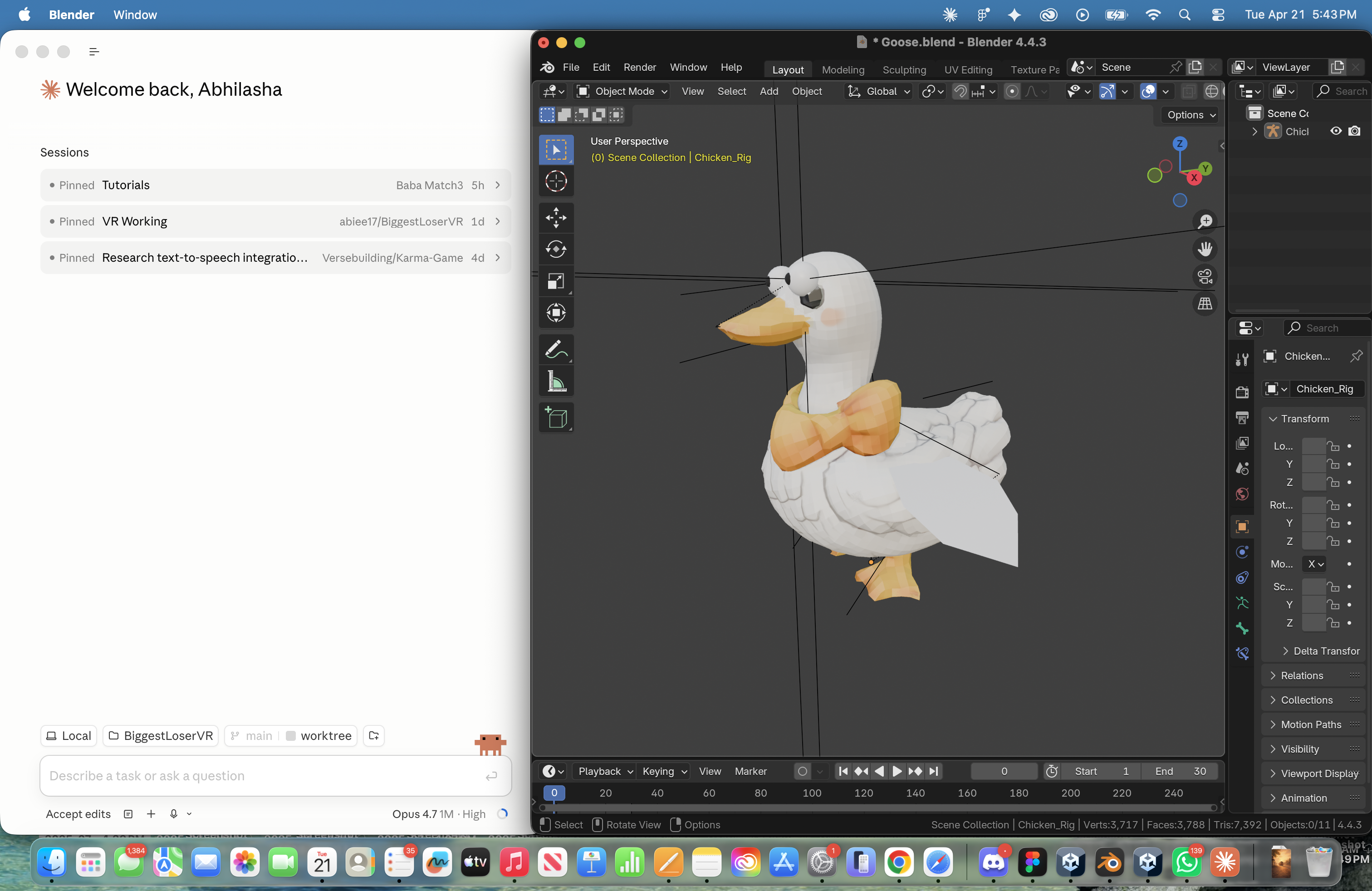
The most non-obvious combination in the pipeline is Meshy + Blender + Claude. Meshy produces a textured base mesh from text or an image in about a minute — fast, but never ship-ready. Blender, driven by Claude through the bpy Python API (via the Blender MCP server), does the surgery that turns the raw output into a game-ready asset: slicing, adding, retopologizing, rigging, animating.

The trap most teams fall into is treating Meshy output as final. The geometry is dense and triangulated, the topology has no edge loops at deformation joints, the mesh is a single shell with no rig points. Drop it into Unity directly and you get a static prop that can't move. The pipeline below is what gets you the rest of the way.

Blender — a Meshy-generated character mid-rig in a Conductor + Blender session: armature visible, the model parented and ready for weight-paint cleanup. The 'surgery' that turns a Meshy gen into a riggable game asset.

The five surgical moves

1 + 8
Average pipeline time per asset
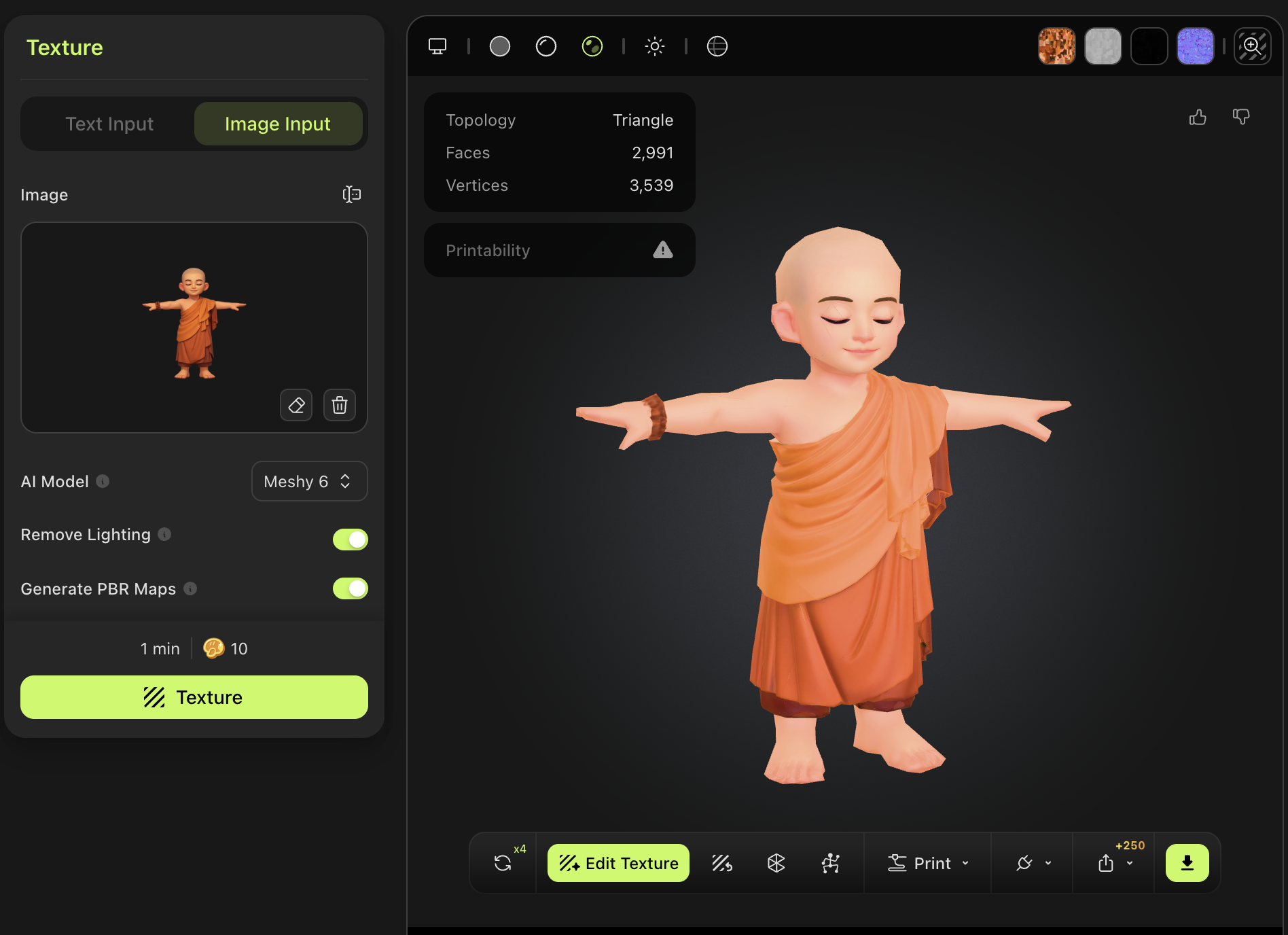
~1 minute in Meshy for the base mesh + texture; ~8 minutes in Blender (driven by Claude over MCP) for slicing, geometry-add, retopo, rig, and an idle animation. Versus 4–8 hours for a 3D artist starting from scratch.

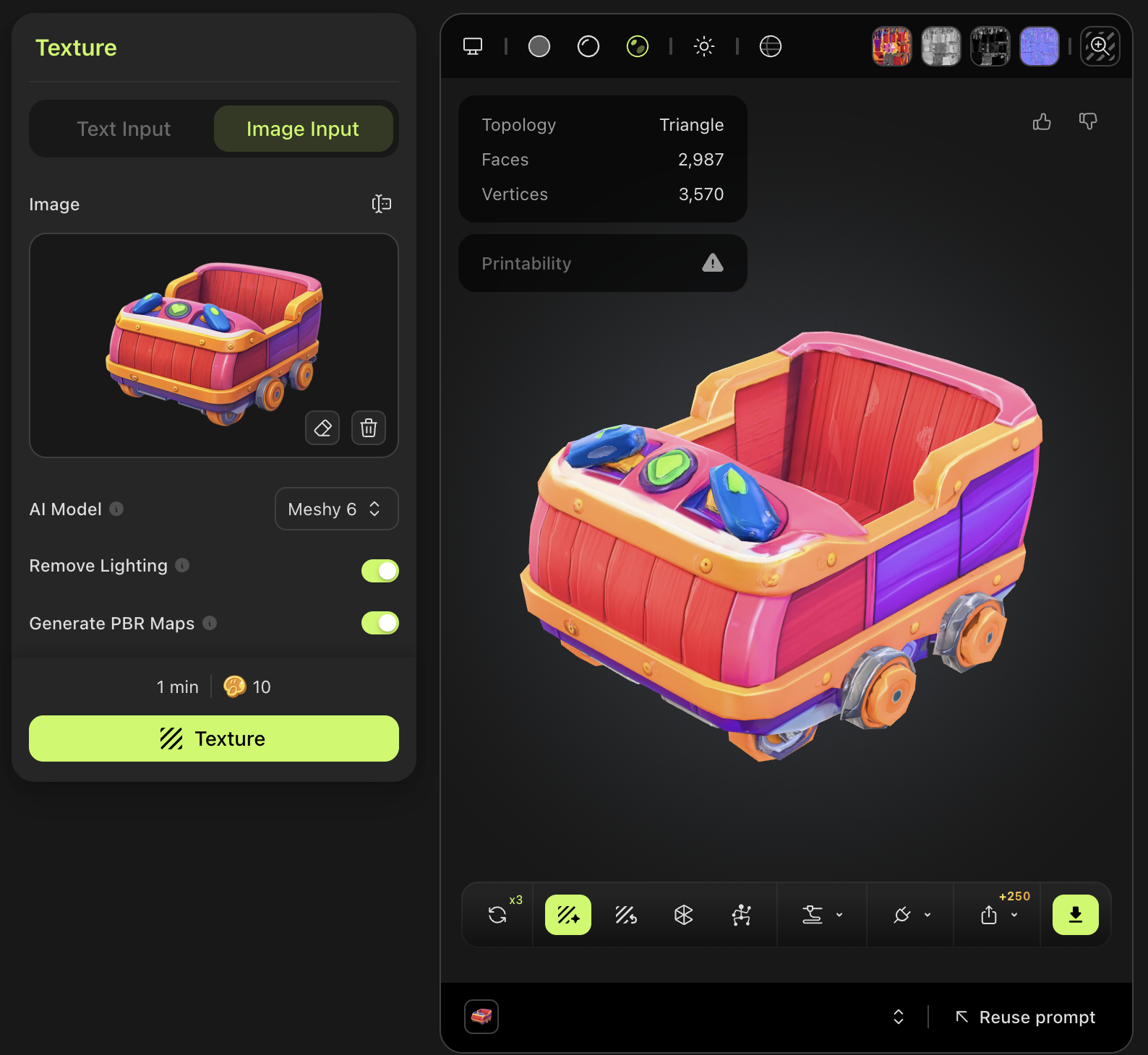
Three pulls from the pipeline: a character (Ananda the child-monk from Karma) and a prop (Riley's mine cart) — both fresh out of Meshy — alongside the same prop after Blender + Unity finished with it: in-engine, riding through Riley's lava world. The Meshy step gets you a clean base. The Blender step (the wide-mock above — the rig surgery happening) is what makes it move. The in-engine result is what the player ends up with.

The same workflow built Karma's hungry-ghost villagers (the masked spirits with internal craving orbs), Sammy's wardrobe variants, Ananda's temple geometry, the Hum Tunnel's neon arch in Riley, and most of Riley's overworld props. Meshy is the input. Blender + Claude is what makes it ship.

Generation gets you to the starting line. The surgery after is the actual game-art job.
§ 04 / Three Games

Same pipeline, three wildly different projects.

↳ where each tool earned its keep

The pipeline isn't a template — each game pulls a different combination of tools. Below: which tool did what on each project, and why that combination.

Mobile · Match-3 · Unity 6 URP

Baba on the Go

  • Claude Code — ~16k LOC across ~100 scripts. Blocker subsystem (Grass / Crate / Honey / Ice / Chains), event-driven manager singletons, performance defaults (HashSet animator-param validation, pooled VFX, lazy caching).
  • Custom Unity editors — Level Designer, Chapter Designer, Cutscene Designer. Built alongside the systems they edit so designers never leave Unity.
  • Suno — chapter themes (Varanasi ghats, Hungry Ghost realm).
  • ElevenLabs — character bubble lines and home-screen narration.
  • Firebase + LevelPlay + GameAnalytics — full F2P shipping stack. ~160 fps with HUD + food-rain pool + NavMesh ghosts + dialogue live.
3D RPG · Multi-platform · Unity 6 URP

The Karma Project

  • Meshy + Blender (Claude) — full character pipeline: narrative brief → Sora concept → Midjourney sheet → Meshy base mesh → Blender cleanup. Five Ghost archetypes (The Listener, The Performer, The Commuter, etc.) generated this way.
  • Claude Code — full RPG systems: 6-state player FSM, 6-state quest FSM with compassionate fail-soft cascade, [SerializeReference] dialogue polymorphism, motion-comic cutscene engine, ~27k-word systems doc co-authored.
  • ChatGPT & Claude (chat) — Buddhist source research (Lotus Sutra, Pema Chödrön on tonglen, hungry ghost preta literature) distilled into chapter arcs.
  • Suno — chapter scores tuned to emotional arc (compassion → awe → release).
  • ElevenLabs — Sammy, Serna, Ananda voicing.
Companion mechanic · Unity

My Friend Riley

  • Claude Code — companion-mechanic systems and behavior orchestration.
  • ElevenLabs — character voice for sustained dialogue.
  • Suno — ambient and emotional cue tracks.
  • Firebase — telemetry on companion-state interactions to tune affective response over time.
  • ↳ details to follow once Riley ships beta
Cross-cutting · across all three

What Claude Code carries

  • Design docs as source of truth — every chapter, system, mechanic drafted in markdown. Claude reads it, generates Unity C# matching spec, no manual translation layer.
  • Long-context engineering — 1M-token window holds an entire chapter's design + code + playtest notes simultaneously, so edits respect invariants without drift.
  • Sub-agent verification — code changes are cross-referenced against existing scripts before generating new ones. Prevents reinventing solved utilities.
§ 05 / Discipline

Five rules that keep slop out.

↳ what makes this a pipeline, not a vibe

The reason most "AI-augmented" workflows produce mush is that they skip the boring part — the discipline that keeps the human in the loop where it matters and out of the loop where it doesn't. Five rules I keep:

  • Design docs are the source of truth. Every system, chapter, and mechanic is drafted in markdown before code or art. Claude reads those directly. The doc and the code stay in sync because the doc generates the code, not the other way around.
  • Editors first. Content second. Custom Unity editor windows (Level Designer, Chapter Designer, Cutscene Designer, Dialogue Editor) get built before the content they author. Saves hours per asset; also forces clarity on data shape early.
  • Long context beats clever prompting. A 1M-token Claude session holds an entire chapter's design, code, and playtest notes at once. Edits respect invariants across the whole arc without drift. Short-context "ChatGPT-as-search" is a different tool for a different job.
  • Verify, don't vibe. Every AI artefact has a check: code compiles + runs, mesh topology is inspected in Blender, voice line is auditioned against character bible, mock is critiqued against the design system. Nothing ships on confidence alone.
  • Taste stays human. Narrative direction, emotional arc, what makes a beat land — these are not delegable. AI executes faster; the human still decides what's good. The moment that flips, the work goes generic.

The combined effect of those five rules is that the ratio of intention to execution inverts. The decisions that used to take weeks — "what should this chapter feel like?" "what's the right cutscene rhythm?" "is this fail-soft or just soft?" — get the time they deserve. The translation from decision to working build compresses to hours.

The pipeline, in action

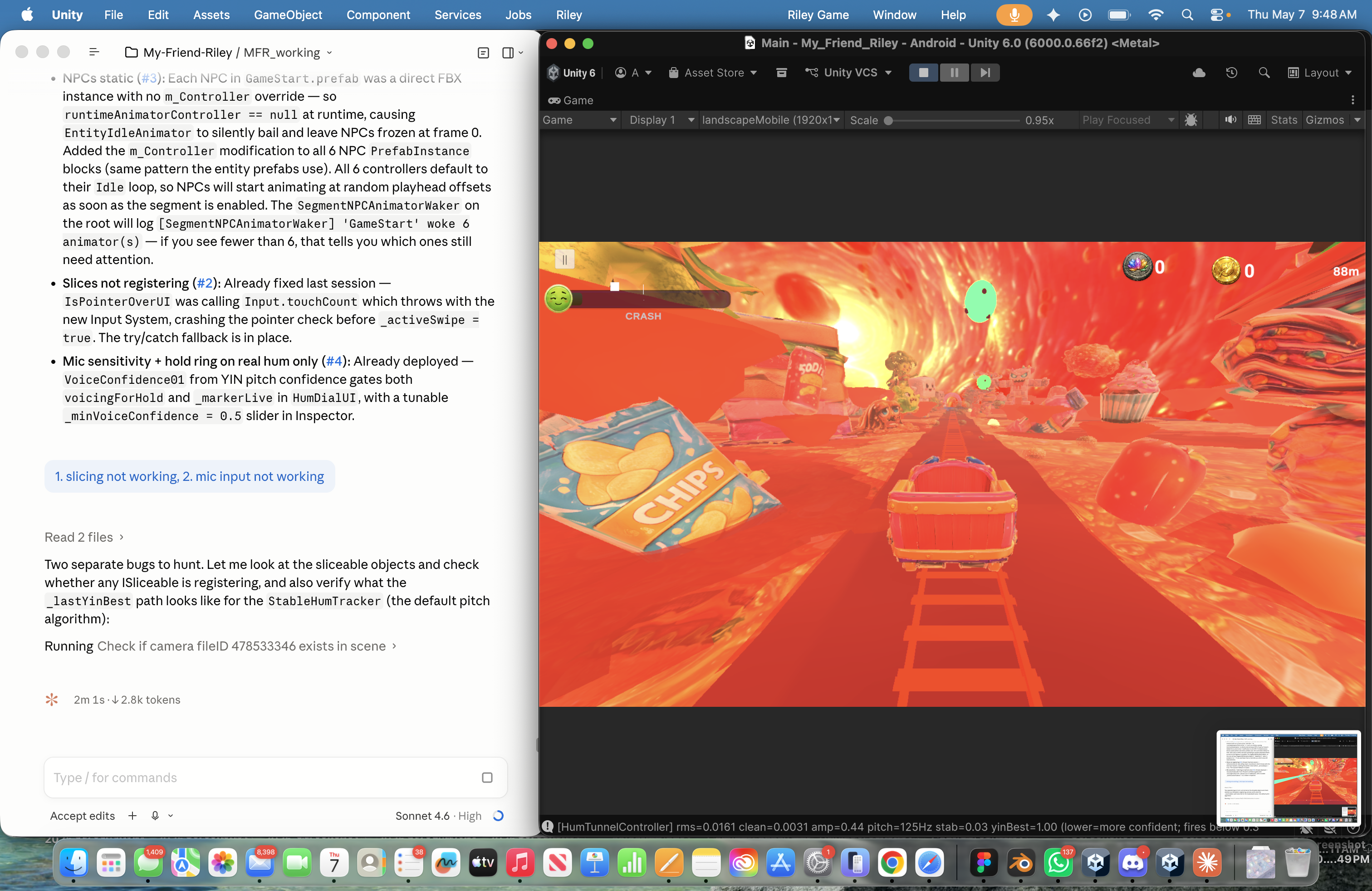
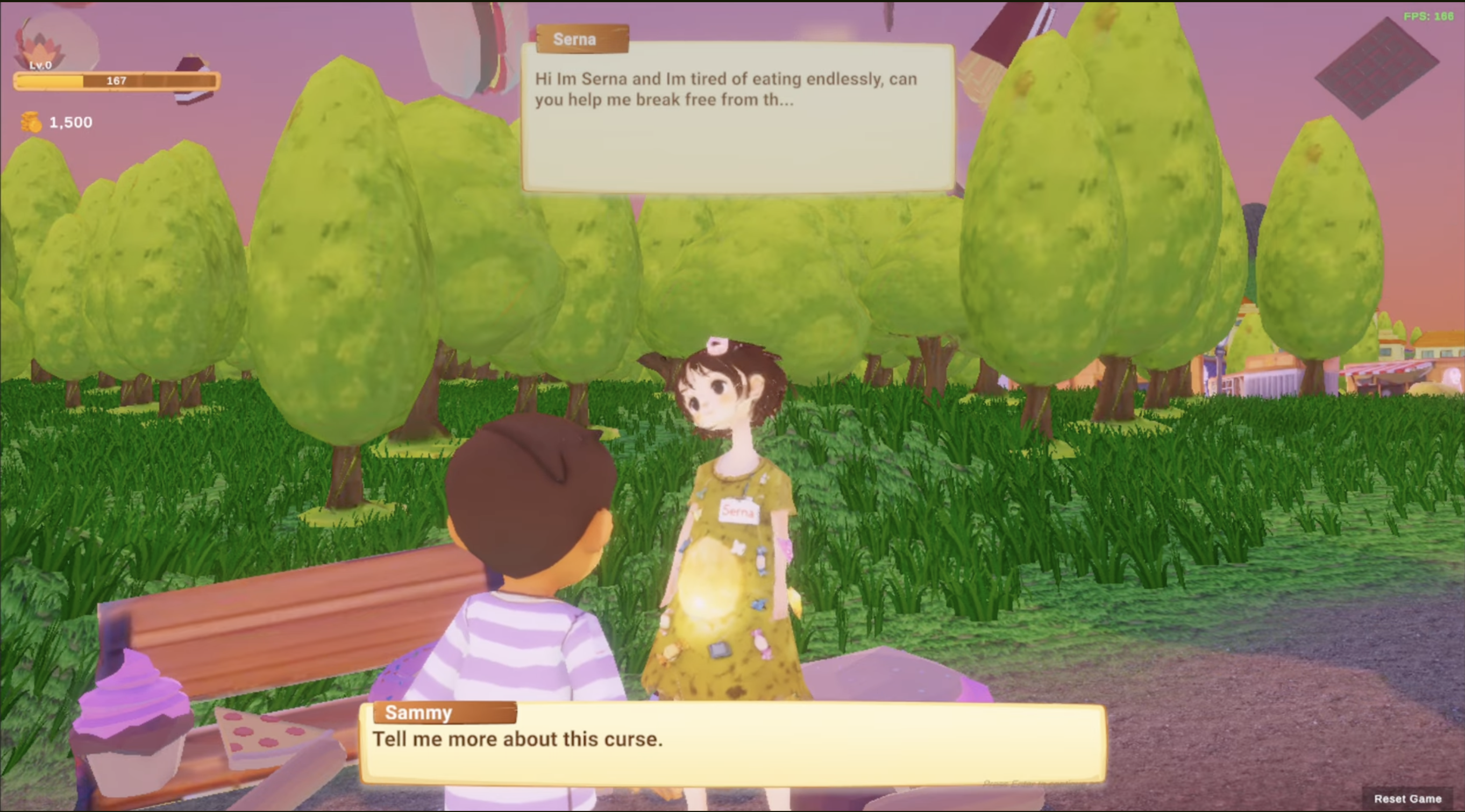
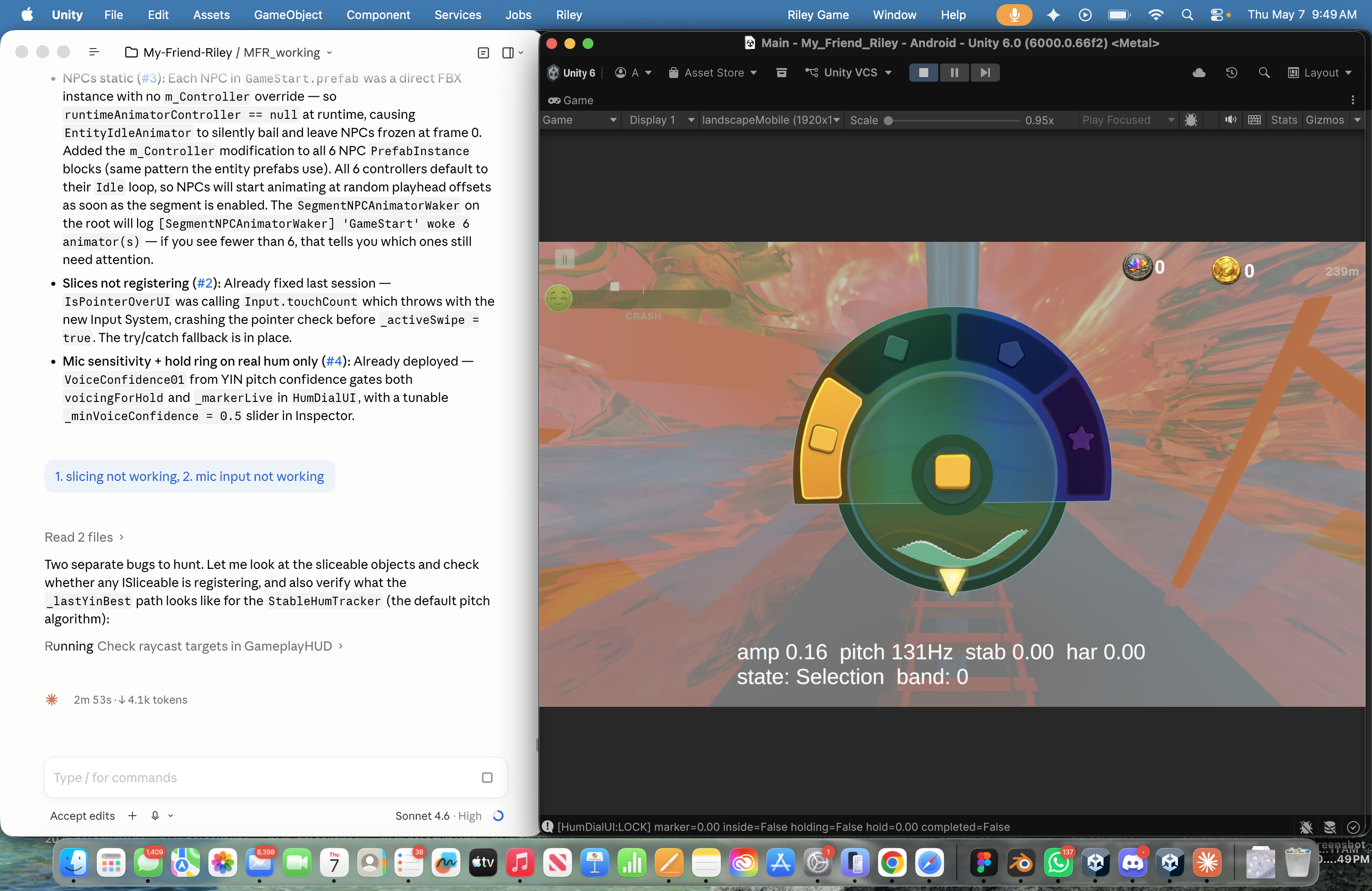
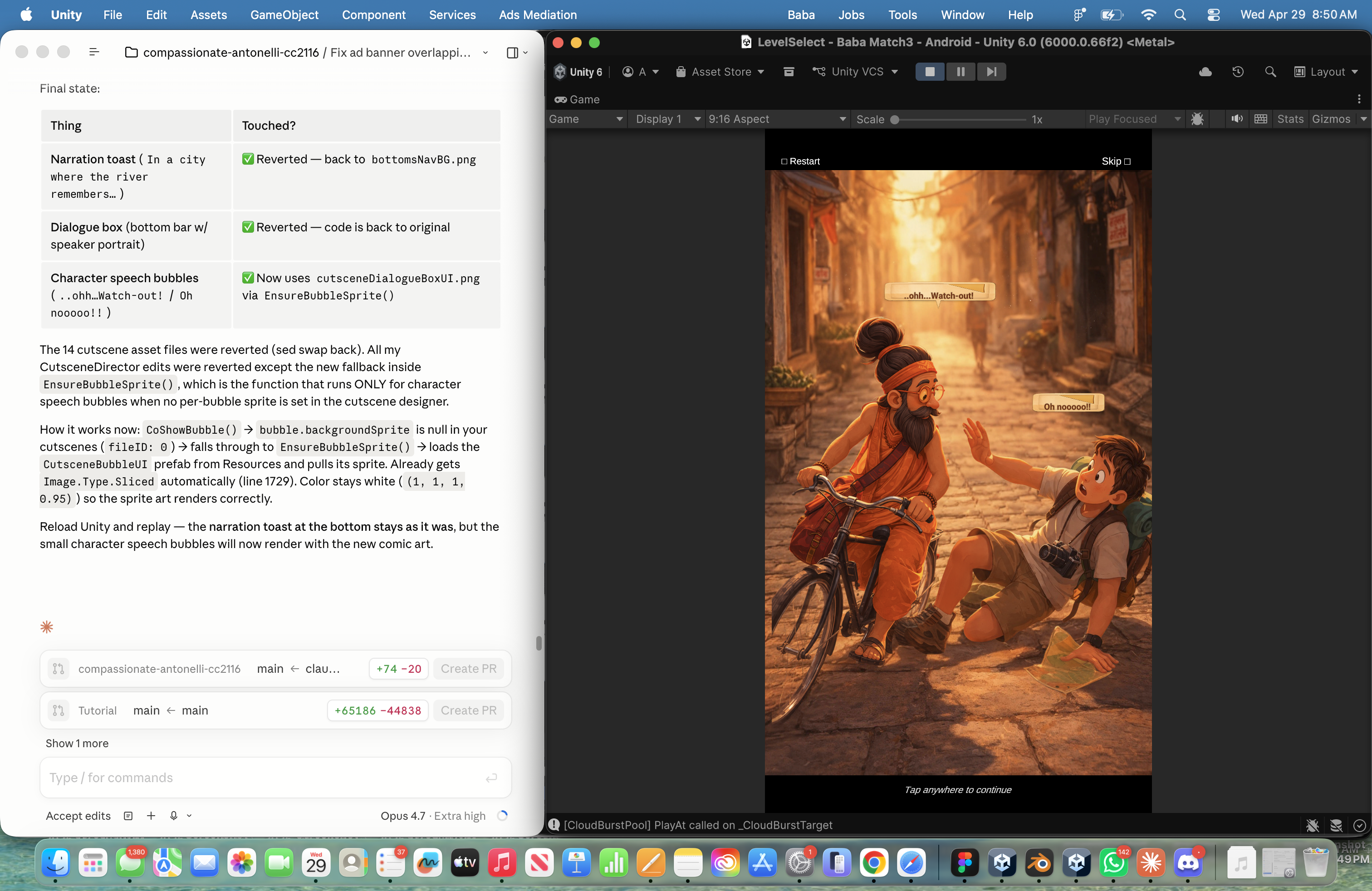
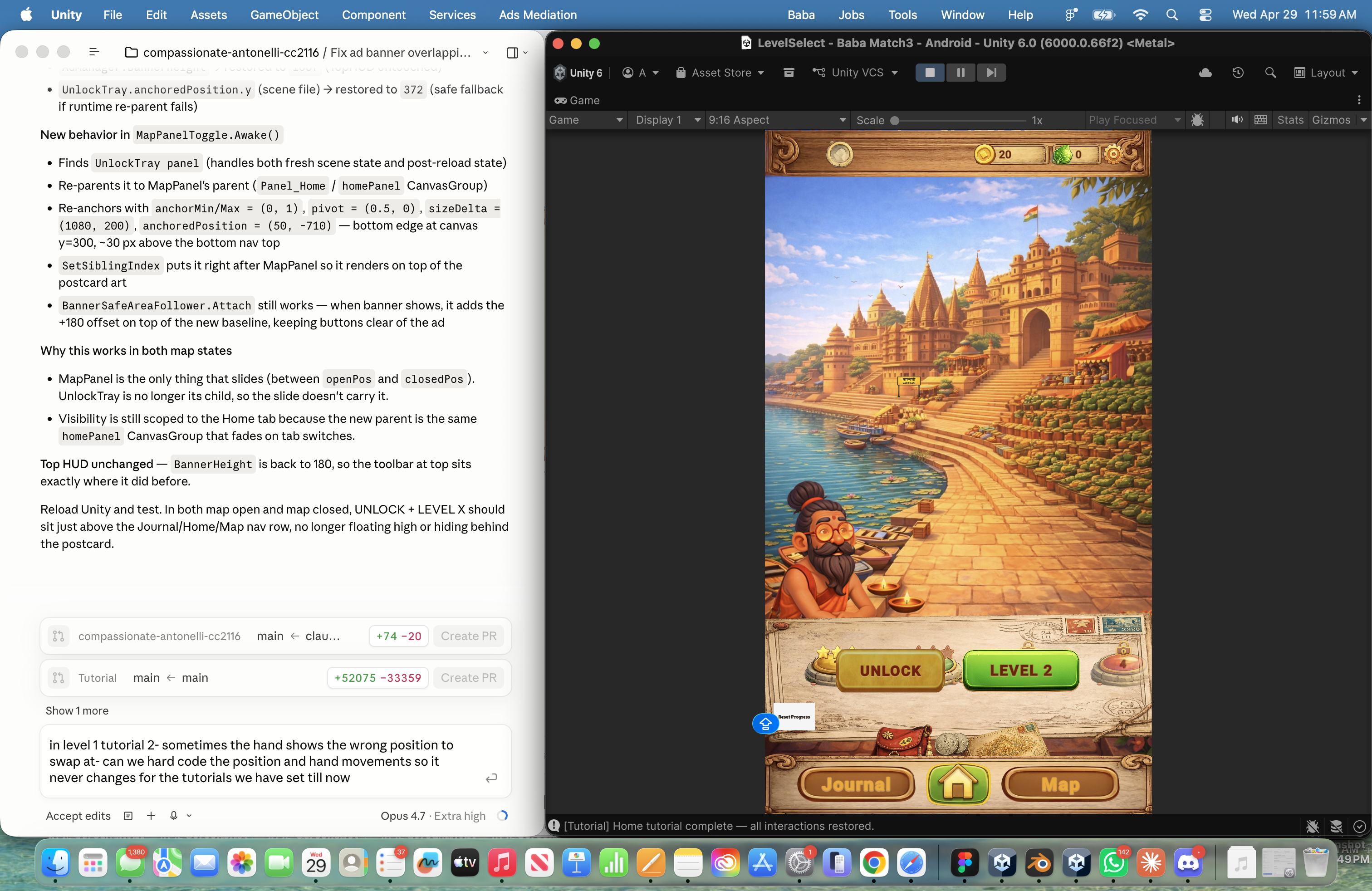
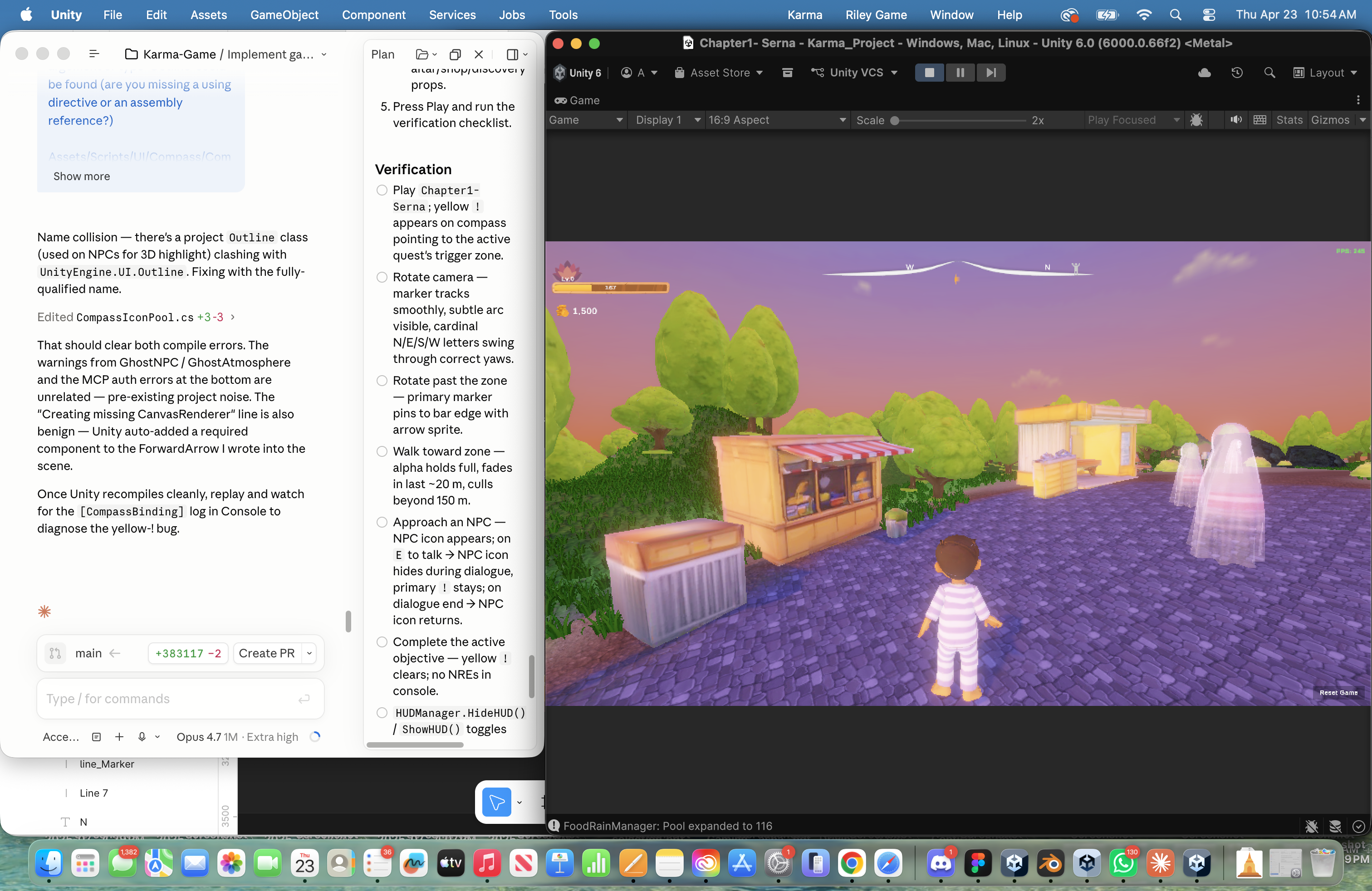
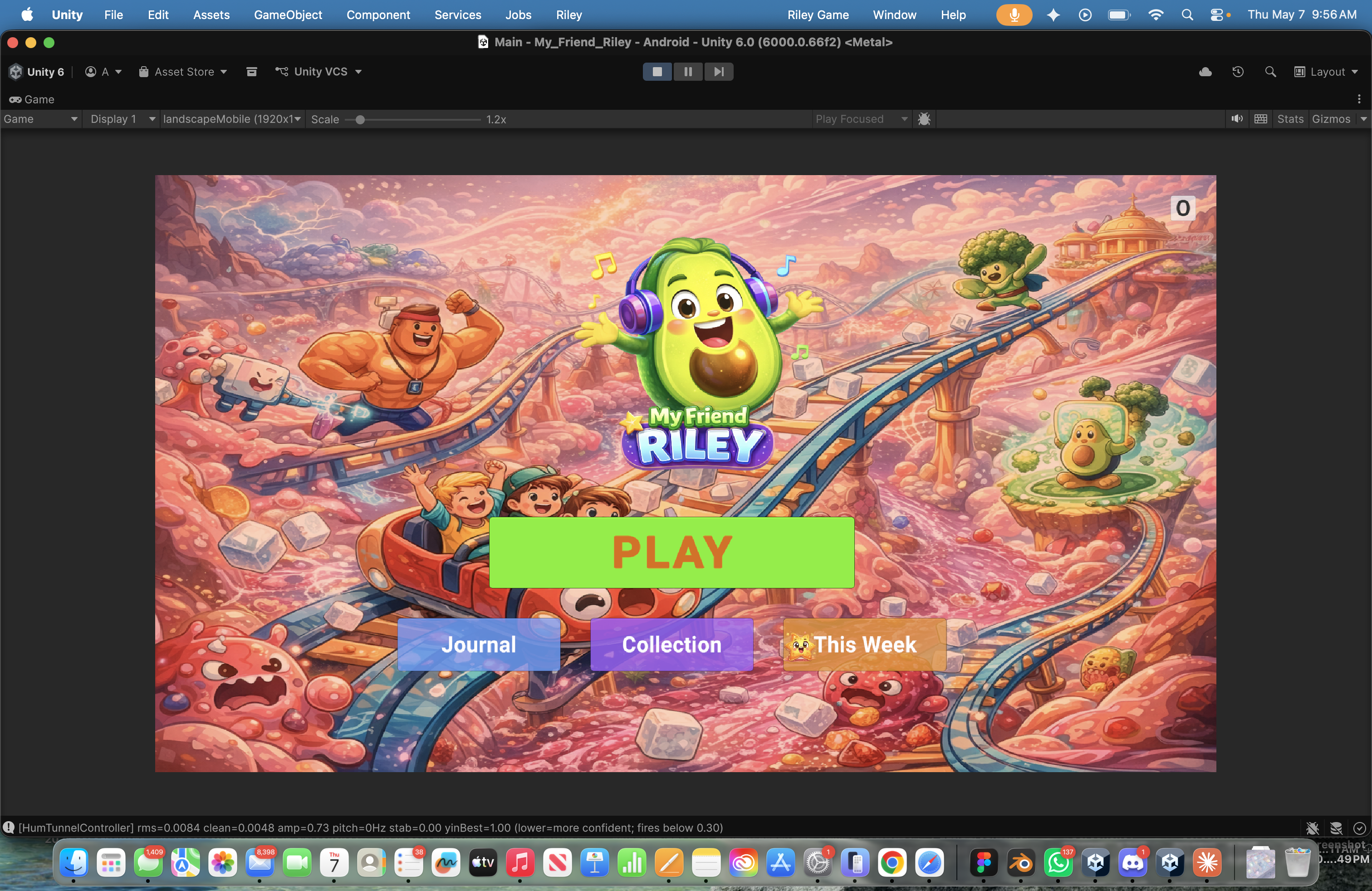
A few stills from real working sessions across the three games — same five rules, three different fictions:

↑ different worlds. one pipeline. one human.

§ 06 / Ship Stack

From editor to play store.

↳ telemetry, monetization, launch

A game that doesn't ship is a hobby. The ship-stack handles the boring infra so the design can stay sharp:

§ 07 / This Site

You're reading the output of the pipeline.

↳ singhabhilasha.com, end-to-end with Claude Code

The portfolio you're on right now is itself an artefact of this pipeline. singhabhilasha.com was built end-to-end with Claude Code — HTML, CSS, JavaScript, case-study writing, deployment, and DNS migration. No CMS, no build step, no framework.

There's a small recursion to enjoy here. The case-study format you're reading is the case-study format I co-designed with Claude. Sections, callouts, the dark-stripe rhythm, the way the eyebrow lines anchor each block — all part of the system. When the system is the artefact, every new case study slots in for free.

The whole site is one Git repo and a CNAME file. Push, done.
§ 08 / Outcome

Three games. One pipeline.

↳ what the pipeline actually produced
3
Games · 3 genres · 3 platforms
9+
AI tools in production
~16k
LOC in Baba alone (Claude-paired)
27k
Words of systems doc, co-authored

Three projects in different genres on different platforms — Match-3 on mobile, narrative RPG on desktop, companion mechanic exploring AR/VR — all carried by a stack of nine specialized AI tools, with one designer-developer-engineer at the centre.

The lesson generalizes: you don't need an AI agent that does everything. You need a pipeline where each stage has a tool with a verifiable output, a human in the loop where taste matters, and a clear rule for when to ship vs. when to redo. The work that used to require six full-time specialists now runs on one human plus nine specialized assistants — each doing the job a senior in that craft would do, faster than the human alone.

The ratio of intention to execution flipped. Decisions that used to take weeks become decisions in afternoons.

The frontier from here is the games where AI isn't just in the pipeline but in the gameplay — where the player interacts with a model at runtime, not just with content the model produced offline. My Friend Riley sits on that line. The same discipline applies: design docs first, verifiable output, taste stays human.

↑ AI doesn't make games. people who know what they want do.